

The cut is craft too.
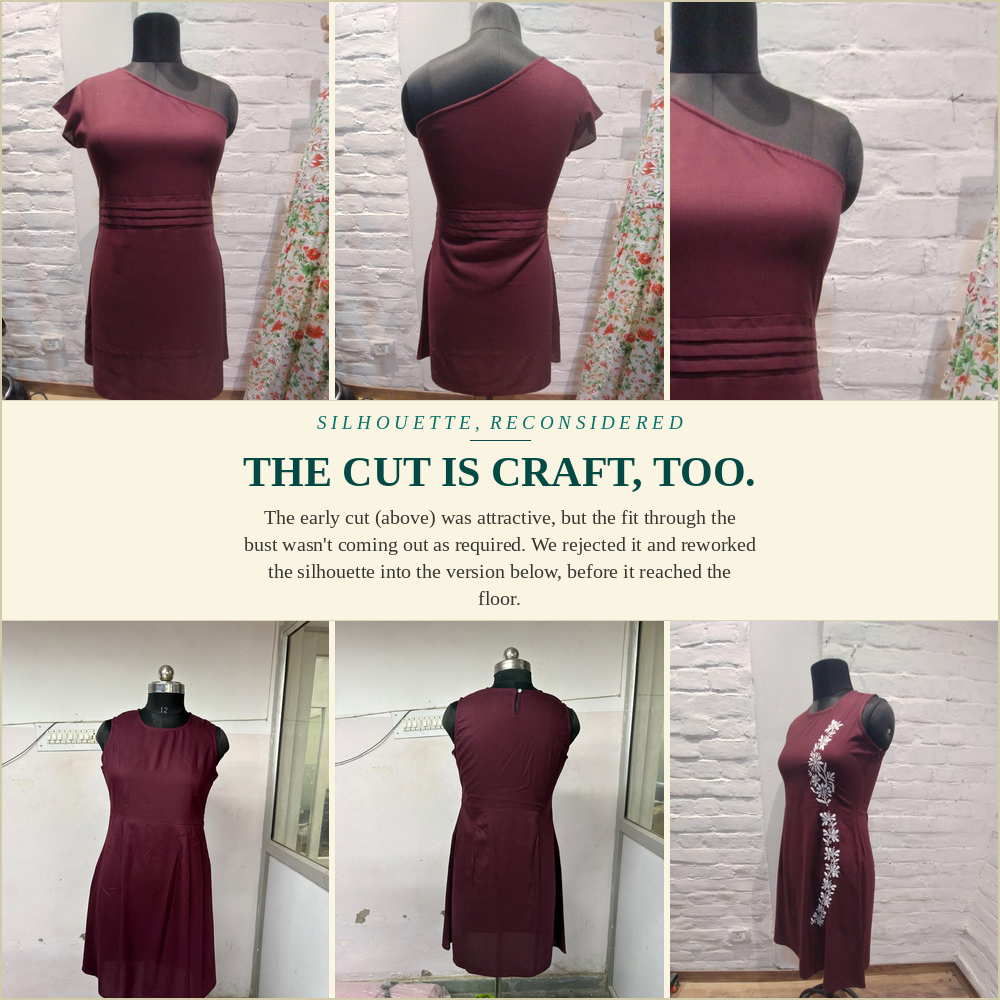
Craft begins before a needle is threaded. Before the fabric is cut, before the embroidery is placed — it begins as a line on paper. A sketch. A proportion decision. A deliberate answer to the question: what shape does this need to be?
For us, the answer has never been incidental. It has been derived from a belief — that Indian craft has to come out of the shadow of occasion wear and appear in the daily wardrobe. This is not easy, because we do not want to make shirts that look like a modified kurta, or trousers that look like a modified pyjama. The silhouette has to earn its place as genuinely new territory, or there is no point.
We work in shirts, dresses, co-ords, and modern separates. Every fit is graded, every proportion is deliberate. Movement — how a sleeve falls, how a hem sits when you sit — is design intelligence, not a finishing detail.
Making a non-standard silhouette work requires makers willing to test it. We work with small manufacturing units — skilled tailors who have chosen to build something considered rather than something fast. A co-ord proportion being tested for the third time because the first two were not right — that kind of iteration requires patience with hypothesis and willingness to remake. The people we work with have both.
The fabric is what you actually live in.
Skin has a memory for comfort. We want your skin to remember us.The base of the collection. Woven, breathable, structured enough to hold a silhouette without stiffening on the body. It presses clean, moves through a full day without complaint, and washes without ceremony.
Where cotton meets a measured proportion of linen, something shifts — a slight weight, a finer drape, a surface that has texture you can feel rather than see. It holds its shape through a long day and softens with every wash. Most of the collection lives here.
The lightest hand in the collection. Fluid and close-moving, with a fall that picks up light differently from woven fabrics. Used selectively — on the pieces where the silhouette asks for movement over structure.
Four centuries.
One rule unchanged.
Somewhere around 1611, a Persian needlework tradition arrived in the Mughal court at Lucknow. Mehrunnisa — known to history as Nur Jahan, wife of Emperor Jahangir — is credited with bringing this craft into the courts of Awadh. The Nawabs who followed made it their own. The city made it permanent.
What emerged was Chikankari — built on a single discipline: white thread on white fabric, flat against the surface, breathable, almost invisible until the light moved. Over four centuries the craft expanded — into colour, into more than thirty-six recognised stitches, into raised work and open trellis and shadow work. The foundational rule never changed: every motif, by hand, one needle pass at a time.
We work across four registers — not collections, not styles, but four deliberate points on a single spectrum.
Across thirty-six stitches and four centuries, the one thing that has not changed is the hand holding the needle.No embroidery. The design speaks through the cut, the fabric, and the proportion alone.
The embroidery is present but unhurried — a motif placed where it earns its place, not where it fills space.
The embroidery is part of the garment's character, not just its surface. You notice it. That is the point.
Motif, placement, scale, and thread come together to define the piece. The embroidery is not decorating the garment — it is the garment.
Each stitch has a persona.
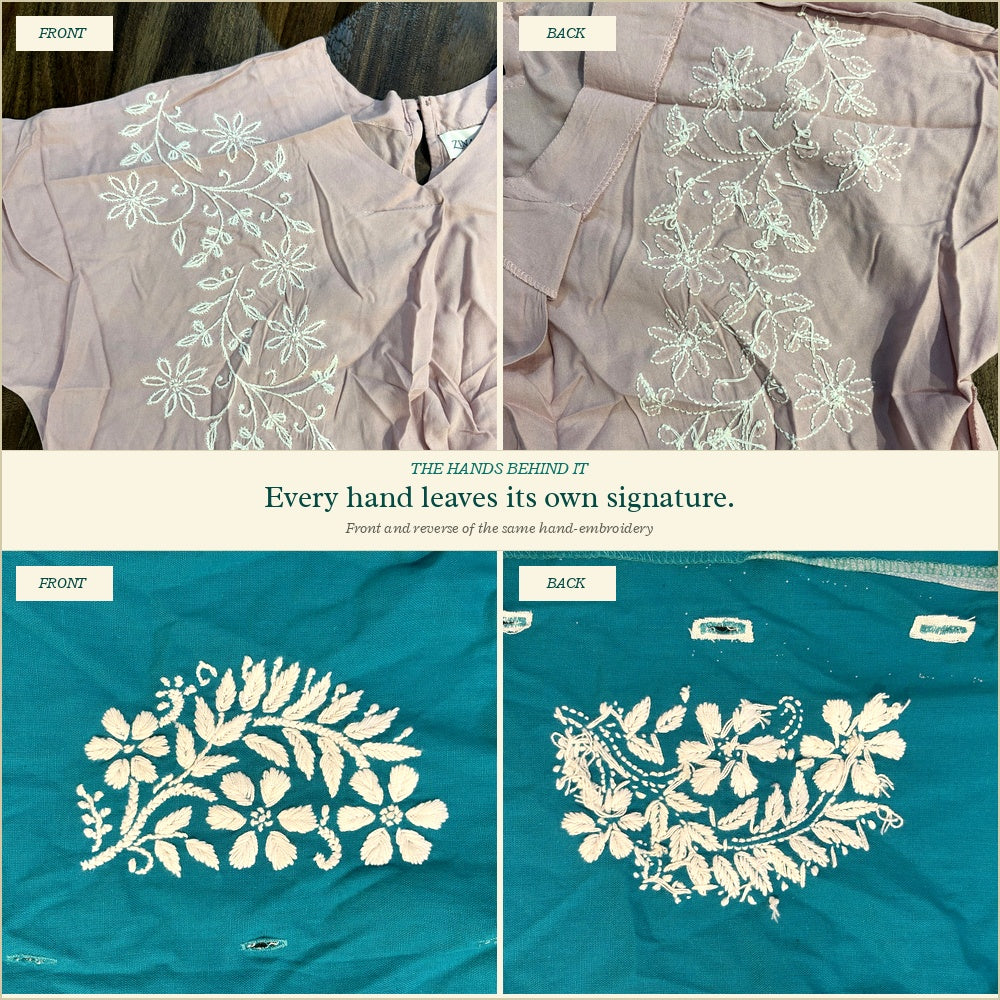
A single Chikankari piece may pass through multiple sets of hands — each one bringing their craft knowledge to your piece, each responsible for exactly the stitches they have spent years mastering.
The embroidery on every Zinavraa piece originates from karigars who work in addas — shared spaces where artisans gather near their living clusters in Chowk, Lucknow — or independently from their homes, all coordinated through a master karigar who knows which hands are right for which stitch.
A piece calling for Ghaspati and Pechni stitches will go first to a Ghaspati karigar who completes every Ghaspati motif across the piece, then passes it to the Pechni karigar. Or a karigar who has mastered both may work it start to finish. The combination varies — the standard does not.
We do not fill a collection.We edit one.
Not everything that comes back from Chowk makes it into a collection. A stitch combination can be technically correct and still be wrong — wrong proportion for the silhouette it sits on, wrong density for the fabric beneath it, right in isolation and wrong in context. When that happens, it doesn't ship.
This means that what you see in a Zinavraa collection is what survived that process — not what was available, not what was fastest to produce. Every fabric and embroidery combination here was a decision, not a default.
It also means it will not repeat. Fabric availability changes, karigar availability shifts, and the precise combination of stitch, placement and cloth that produced a specific piece is unlikely to align again in exactly the same way. What is here now was made to be here now.
More from Zinavraa

7 day return window
Request a return within 7 days of delivery
Free Shipping across India
Free on orders above ₹1,900
Cash on delivery
COD available, additional ₹200 charged (incl. GST)
Secure Payments
Transact with 100% safety.